
Common Sense on Eilean Darrah
A Buddhist take on Common Sense

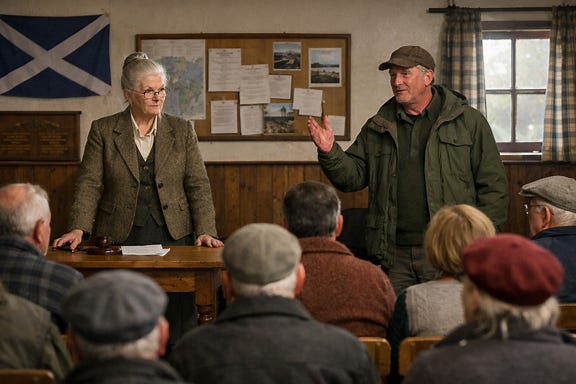
Eilean Darrah was the kind of Scottish island where everyone knew everyone else’s business, and most of them disapproved of it. The population hovered somewhere around sixty‑three, depending on who had taken the ferry that week, and the island’s only connection to the mainland was the Friday boat that brought mail, supplies, and the occasional bewildered tourist who had meant to go to Mull.
The island was overseen by Provost Morag MacLeod — a woman of formidable posture and an approach to leadership that could best be described as “iron‑clad shepherding”. She believed in order. She believed in rules. She believed in meetings that ran on time, even if nothing useful happened in them.
Lately, though, the island had been fraying at the edges. Arguments over fishing rights. Squabbles about who was responsible for repairing the community hall roof. A full‑blown feud between two families over a missing wheelbarrow. On a small island, these things echo.
So Morag called a community meeting.
It did not go well.
Within ten minutes, three people were shouting, two were sulking, and one elderly crofter had fallen asleep in protest. Morag banged her gavel — she always brought a gavel — but the room only grew louder, more tangled, more hopelessly human.
And then Callum Buchanan stood up.
Callum was the island’s forest ranger, though “forest” was a generous term for the cluster of wind‑bent pines on the north ridge. He was a quiet man, known mostly for rescuing lost sheep and talking to trees in a way that made the trees seem the sensible ones.
He cleared his throat.
“Folks,” he said, “we’re forgetting something.”
The room didn’t quieten so much as wobble into a confused pause.
“We keep talking as if we’re separate,” Callum went on. “As if the island is made of sixty‑three little worlds bumping into each other. But everything here is connected. The wind that knocks down Angus’s fence is the same wind that dries Mairi’s washing. The ferry that brings the mail brings it for all of us. Even the midges don’t discriminate.”
A ripple of reluctant laughter.
Callum nodded. “Common. That’s the word. Everything on this island is common. Shared. Interwoven. We depend on each other more than we admit.”
He tapped his temple. “And sense — well, that’s not just thinking. It’s the way things feel when we stop trying to be right and start trying to be real. Common sense isn’t cleverness. It’s the wisdom that shows up when we remember we’re part of something bigger than ourselves.”
The room softened. Shoulders dropped. Someone sighed in that way people do when they’ve been holding their breath for months.
Callum finished quietly: “We survive here because we’re connected. We always have. Maybe it’s time we acted like it again.”
Silence settled — not the tense kind, but the kind that feels like the island itself is listening.
Provost Morag looked at Callum for a long moment. Something in her expression shifted, like a door opening a fraction. She set down her gavel.
“Right,” she said. “No more iron control. Let’s do this together.”
And just like that, the room changed. People leaned in instead of away. Ideas flowed. Offers of help appeared. The wheelbarrow feud was resolved when it turned out the wheelbarrow had been sitting behind the hall the entire time.
By the end of the night, the community had a plan — for the roof, for the fishing rights, for the ferry schedule, for the future.
As they stepped out into the salt‑bright air, Callum paused by the door. The wind tugged at his jacket. The pines on the ridge swayed in agreement.
Common sense, he thought, wasn’t something you found.
It was something you remembered.
__________________________________________________________________________
Common Sense - The Commentary
We throw the phrase around all the time — Use your common sense, It’s just common sense, Come on, it’s obvious.
But when you sit with the words for a moment, they open up into something far more interesting, and far more Buddhist, than we usually notice.
Let’s start with common.
In the Buddha’s world, nothing stands alone. Everything is leaning on everything else, all the time. This is conditionality: the great web of causes and conditions that makes the universe possible. Your breath depends on a tree. The tree depends on sunlight. The sunlight depends on a star that is burning itself into emptiness. And your thoughts — even the ones you think are “yours” — arise from a lifetime of conditions you didn’t choose.
So in a very real sense, everything is common. Shared. Interwoven. There is no private corner of the universe where a self sits in splendid isolation. We are stitched into one another.
Then we have sense.
In Buddhism, this isn’t a vague intuition. It’s literal: the six sense bases — sight, sound, smell, taste, touch, and the great conductor of the orchestra, mind. These are the ways the world arrives. These are the channels through which experience is born.
When you put the two words together — common and sense — something lovely happens.
Common sense isn’t a dry, rational calculation. It’s not academic. It’s a felt knowing. A grounded, embodied wisdom that arises when the mind is not tangled up in self‑concern. It’s what appears when we’re not trying to be clever, or special, or right. It’s what’s left when the noise quietens.
Why does it feel so trustworthy?
Because it doesn’t belong to “me”.
It comes from something wider — the shared field of experience we all participate in.
When you say, It just feels right, what you’re really saying is:
This aligns with the deeper pattern of things. This resonates with the way life actually works.
Common sense is common because it’s connected.
Common because it’s grounded in the senses.
Common because it arises from a wisdom that isn’t owned by anyone — it’s simply part of being human.
And perhaps that’s the invitation:
To stop trying to manufacture wisdom, and instead to listen for the wisdom that’s already here. A wisdom that is beyond an individual academic mind.
In the breath. In the body. In the simple, ordinary, shared experience of being alive.
That’s common sense.
I really enjoyed the story that preceded the reasoning. It shows a great, if not maybe simplistic, way in which we can communicate with each other better. How we can could have some empathy for each other instead of looking only at our own issues and how compassion for each other and the environments we live in are really quite important.
(That’s my take). 🙏
Thank you for sharing this Andy.
Thanks for another great piece, Andy.